When SAP TM works exactly as designed, but the business process still fails
Technical success is not business success, from the person who carries production support.
One of the more interesting situations in SAP Transportation Management is when the system is technically doing exactly what it was designed to do, yet the business process still does not work as expected. A Freight Order may have been created correctly. The right Freight Units may have been assigned. Transportation charges may have been calculated. From a system perspective, everything can appear correct.
And still, the business user has a problem.
Working with SAP TM in production has taught me that understanding this distinction is important. Not every unexpected business result is a system error, and not every incident requires a configuration change.
Sometimes, SAP TM is simply doing exactly what we asked it to do.
Start with a different question
When an issue is reported, the natural first question is often:
"Why is SAP TM not working?"
I have found that a better question is:
"What did we expect SAP TM to do, and what did it actually do?"
The difference may seem small, but it changes the way an incident is investigated. If the system created a Freight Unit or Freight Order according to the existing configuration, the first task should not necessarily be to change the configuration. Instead, we need to understand the gap between the system’s behaviour and the business expectation.
- Has the business process changed?
- Is this a new transportation scenario?
- Is a new carrier involved?
- Has some master data changed?
- Is the same configuration being applied to a scenario for which it was never originally designed?
Answering these questions often provides more direction than immediately looking for a technical error.
The Freight Order is only part of the story
SAP TM does not operate in isolation.
A transportation process can involve master data, planning, execution, purchasing, freight settlement, finance, ERP integration and external interfaces. SAP documentation itself describes Freight Order Management as integrated with areas including master data, planning and freight settlement. This becomes particularly important during production support.
Consider a situation where a Freight Order has been successfully created and executed, but the subsequent settlement process fails. From an operational point of view, transportation happened successfully. From an SAP TM perspective, the Freight Order may also appear correct. But the overall business process has still failed.
The root cause might be related to purchasing data, Business Partner information, organisational assignments, charge calculation, integration, or another dependency in the end-to-end process. The location where an error becomes visible is therefore not necessarily the location where the problem originated.
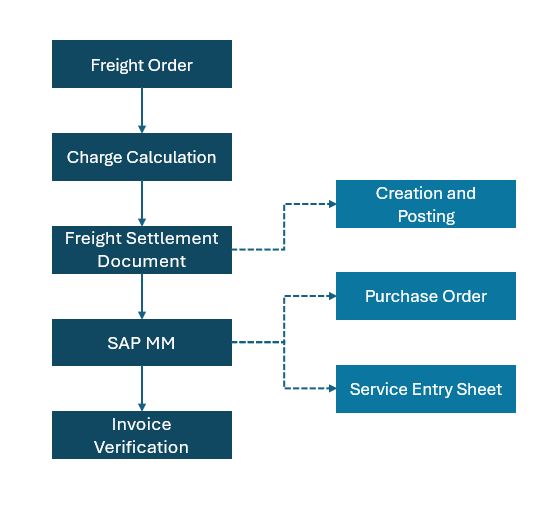
A good example is freight settlement. A Freight Order can be successfully planned and executed, while the subsequent settlement process still fails because the Freight Settlement Document (FSD) depends on purchasing and organisational data beyond the Freight Order itself. When the FSD is transferred to SAP MM, the process involves the creation of a purchase order and service entry sheet, meaning that an issue in purchasing data or organisational assignments may first become visible at this later stage.
Before changing configuration, understand what changed
Configuration changes can be tempting when a process suddenly stops behaving as expected.
Two questions do most of the diagnostic work here, and I covered both in more depth in my earlier article, What Nobody Tells You About SAP TM After Go-Live: what changed, and what is different between a failing document and a working one? If the same process worked previously, something is different now: a new carrier, different master data, a new organisational assignment, or a change in an external or integrated process. And if one Freight Order fails while hundreds of similar ones work, comparing the failing document with a successful one turns an open-ended investigation into a comparison exercise.
An SAP-authored blog on SAP Community, analysing three months of TM support tickets, points the same way: recurring incidents span Freight Orders, ERP/TM integration, Freight Settlement Document posting errors, EWM/TM integration, data inconsistencies and deleted queues.
Changing configuration before understanding the difference can solve the immediate symptom while introducing another problem elsewhere.
Technical success does not always mean business success
This is an important distinction in enterprise systems.
Technical success might mean:
- A document was created.
- A message was successfully processed.
- A determination rule returned a result.
- A Freight Order reached the expected status.
- A calculation completed without a technical error.
Business success is different.
The transportation process needs to produce the outcome that the organisation actually requires. A technically successful result that requires repeated manual corrections, creates downstream problems, or does not reflect the intended business process should still be investigated. This is where understanding the business process becomes just as important as understanding SAP TM configuration.
Sometimes the incident is telling you something bigger
Production incidents are often treated individually.
A user reports a problem, support investigates it, someone corrects the document, and the ticket is closed. That may solve today's problem. But repeated incidents can also reveal something about the underlying process. If users repeatedly need the same manual correction, perhaps the process needs to be reviewed. If the same type of master data issue appears repeatedly, perhaps the real problem is data governance.
If an integration constantly requires intervention, perhaps the interface or the surrounding process deserves closer attention. If the system behaves correctly but users consistently expect something different, perhaps the business requirement and the system design are no longer aligned. The objective of production support should therefore not only be to restore the process. Where possible, it should also help prevent the same issue from returning.
Knowing when not to change the system
As functional consultants, we spend a lot of time learning how to configure systems.
With experience, I believe another skill becomes equally important:
Knowing when not to change the configuration.
Not every production incident requires a system change. Sometimes the solution is correcting master data. Sometimes it is fixing an integration issue. Sometimes it is clarifying the business process. And sometimes the system is behaving correctly, and the requirement itself needs to be reconsidered.
Final thoughts
When a business process fails, it is easy to start from the assumption that something in SAP TM needs to be fixed.
But the better starting point is understanding the complete process.
- What did the business expect?
- What did SAP TM actually do?
- What changed?
- Does the same scenario work elsewhere?
- And most importantly, where does the problem really begin?
SAP TM is part of a connected transportation landscape involving people, processes, master data and multiple systems. A problem may appear in a Freight Order while its root cause exists somewhere entirely different.
Sometimes the most important discovery during troubleshooting is not finding out why SAP TM failed.
It is realising that SAP TM did not fail at all.
Sources
- SAP SE: Freight Order Management. SAP Help Portal, SAP Transportation Management 9.6 FPS02; the equivalent chapter exists in Transportation Management for SAP S/4HANA. help.sap.com (accessed 6 October 2026). Documents the integration of Freight Order Management with master data, forwarding order management, planning, freight settlement, dangerous goods, global trade and basic functions.
- SAP Community (SAP-authored blog): SAP TM Incidents and Support. Published 25 October 2023. community.sap.com (accessed 6 October 2026). Reports a pattern analysis of three months of SAP TM support tickets covering freight orders, ERP/TM integration, Freight Settlement Document posting errors, EWM/TM integration, data inconsistencies and deleted queues.
- SAP SE: Freight Settlement Document. SAP Help Portal, Transportation Management (TM) in SAP S/4HANA, version 2025 FPS02 (October 2026). help.sap.com (accessed 7 October 2026). States that posting the freight settlement document creates a purchase order for services and a service entry sheet in MM, forming the basis for invoice verification.
- Note on evidence: the troubleshooting practices described in this article are the author's practitioner evidence from SAP TM production support.
Next: meet Harshan Surendran, read his first piece, What nobody tells you about SAP TM after go-live, or continue in the SAP TM Hub.