SAP TM for cruise provisioning: a design concept
When the ship sails on schedule, the port call becomes the plan.
Design perspective: an original solution concept, not a description of an existing cruise-line implementation.
Summary
Cruise provisioning presents a distinctive supply chain challenge: thousands of food, beverage, hotel, retail and engineering items must reach a vessel at the right port, within a narrow receiving window, in the right quantities and under the required handling conditions.
Unlike a conventional distribution centre, a cruise vessel follows a published itinerary. Its port call creates a time-bound logistics commitment. Missing the vessel's receiving window can mean an urgent replacement shipment, additional transport expense, unavailable onboard materials or disruption to planned services.
The proposed solution is to use SAP Transportation Management (SAP TM) as the transportation coordination and planning layer connecting supplier shipments to the vessel's port-call schedule.
The concept brings together:
- Port-call-aware transportation planning.
- Multi-supplier freight consolidation.
- Temperature-controlled transport for fresh and frozen provisions.
- Carrier selection, freight costing and execution visibility.
Business KPIs measure cost, service reliability and waste reduction: delivery within the receiving window, emergency shipment frequency, transport cost per call, and temperature exceptions.
Why is cruise provisioning a transportation planning problem?
Perishable provisions
Fresh produce, seafood, meat and dairy have different temperatures, handling, shelf-life and delivery requirements. A transport plan must respect product compatibility and cold-chain controls, not merely truck capacity.
A fixed port-call window
The vessel's arrival, berth availability, provisioning slot and departure time constrain when goods can be received. A late truck may have no practical opportunity to deliver before departure.
Many suppliers, one destination
Provisions may originate from local food distributors, beverage suppliers, central warehouses, and specialist engineering vendors. Separate shipments can increase transport costs and complicate receiving operations.
Different operational priorities
A missing critical spare part, a late fresh-food shipment and a delayed non-urgent retail item have different consequences. The planning process needs priority and service rules.
The central design question is:
How can a cruise operator coordinate shipments from multiple suppliers so that each required provision reaches the correct port, within the vessel's receiving window, at the lowest feasible total logistics cost without compromising food safety or service continuity?
Solution in brief
- Idea: the vessel’s port-call schedule becomes a planning constraint inside SAP TM.
- Standard SAP TM: freight units, time windows, consolidation, carrier selection, freight cost and execution monitoring.
- Proposed extensions: Port Call ID, cold-chain sensor integration. These are not standard SAP.
- Deployment assumption: TM embedded in SAP S/4HANA, on-premises or Private Cloud Edition. SAP references point to the Transportation Management in SAP S/4HANA 2025 documentation.
- AI-based predictive estimates (optional) could help anticipate provisioning arrival times by combining shipment status, route conditions, and historical transit patterns, with the predicted arrival checked against the port’s receiving window and vessel departure schedule.
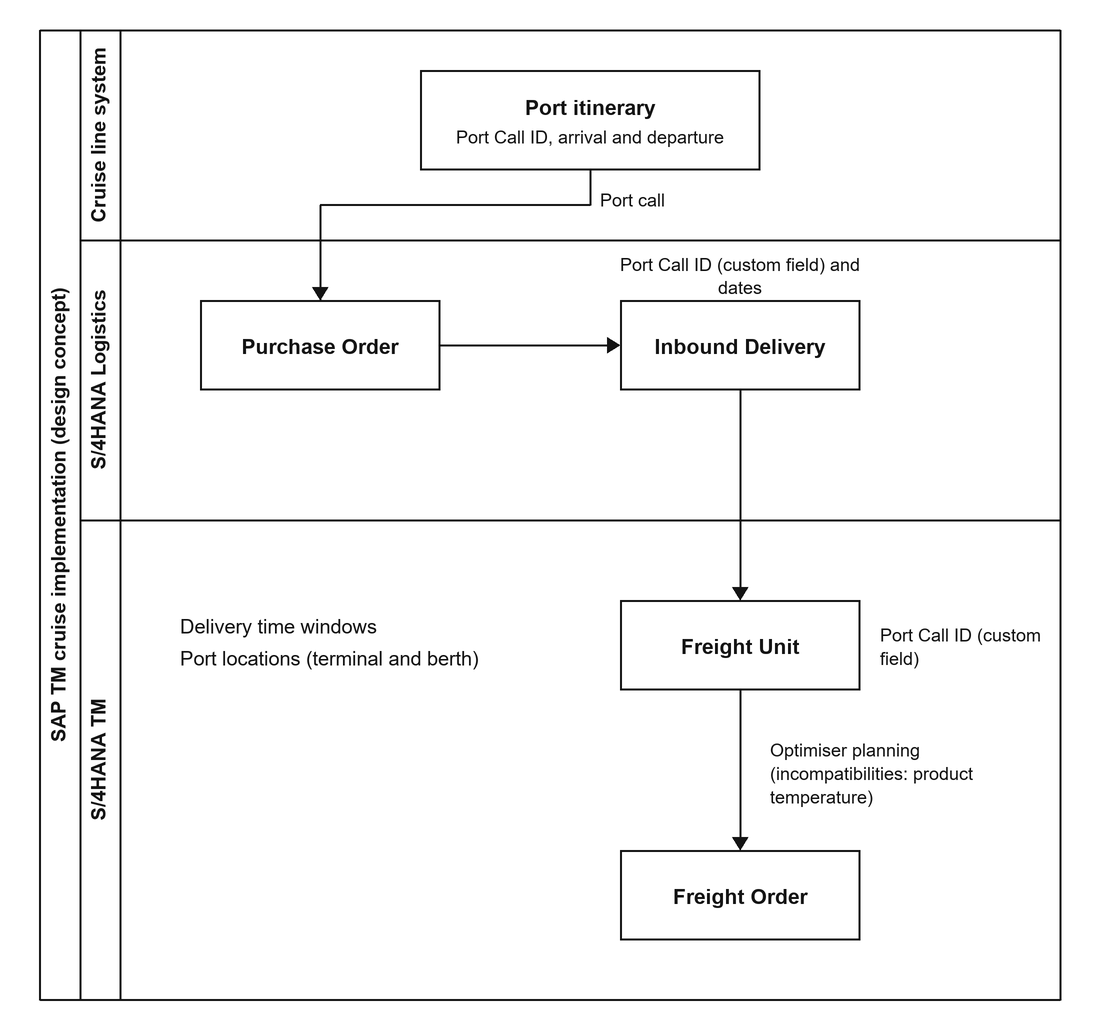
The process in seven steps
- Cruise ops/ERP raise provisioning demand (orders, quantities, dates).
- SAP TM builds freight units from the source documents.
- The port-call receiving window is mapped to TM pickup/delivery windows. The Port Call ID travels as a custom field on the purchase order and inbound delivery and is copied into the freight unit so that it remains traceable on the freight order. This identifier ensures that every shipment is linked to the correct vessel call. However, it is the mapped dates and planning rules in SAP TM that actually enforce the receiving window.
- The planner consolidates compatible supplier loads, respecting temperature and food safety rules.
- TM selects carriers (fixed assignment or tendering) and calculates freight cost against the required service level.
- Carriers dispatch, and the control team monitors ETA and milestones.
- The vessel receives and reconciles goods, and costs are settled.
Constraints
Hard constraints: food safety, security, and departure cutoffs. These can never be traded for cost. The vessel’s port call window must be treated as a hard constraint in SAP TM optimisation. If it were configured as a soft window, the optimiser could accept lateness against a penalty cost, but cruise provisioning cannot tolerate missed cutoffs because the ship departs on schedule. The window must also leave time for unloading and handover before departure.
In SAP TM, incompatibility rules ensure that freight units are grouped only with loads requiring similar temperature ranges, so fresh produce isn’t consolidated with frozen seafood. But this does not prove that the required temperature was actually maintained once the truck is dispatched. That’s why the proposed extension of cold-chain sensor integration matters: sensor readings are monitored during transport, and if a deviation occurs, an exception is raised. The receiving team then decides whether the affected goods can be accepted or rejected.
Soft constraints: delivery sequence and cost preferences.
Worked example
A cruise call at Minato Mirai (Yokohama, Japan), with one port call and one Port Call ID on three inbound deliveries: chilled food, frozen provisions and a critical spare part. The ID only groups them. What the optimiser does depends on the mapped delivery window and the temperature incompatibility rules. Chilled and frozen can’t share equipment, so they become separate freight orders on separate reefer settings. Each could still consolidate with other loads of the same temperature class bound for the same call. The spare part has no temperature constraint but is time-critical, so I would keep it off the consolidated loads and give it its own dry vehicle and a priority flag. A delay on a food load then can’t hold it back. That gives three freight units and three freight orders, with one Port Call ID tying them together for tracking.
Disruption: suppose the berth changes within Yokohama and the vessel arrives six hours earlier, which pulls the receiving window forward. The ID stays the same and enforces nothing, so the dates must change at the source: port operations update the itinerary, and the interface (still to be defined) carries the new dates to the purchase order and inbound delivery.
Conclusion
SAP TM, combined with port-call-aware planning, multi-supplier consolidation, cold-chain visibility, and AI-driven insights (optional), offers an opportunity to make cruise provisioning more efficient, cost-effective, and reliable. This proposed solution aims to reduce transportation costs, minimise delays and food waste, and support reliable delivery of the right supplies to the vessel at the right port and time.
The vision is simple: align transportation with the vessel’s schedule and transform cruise provisioning into a smarter, more connected supply chain.
Sources
- SAP SE: Freight Unit Building Rule. SAP Help Portal, Transportation Management (TM) in SAP S/4HANA, version 2025 FPS02 (October 2026). help.sap.com (accessed 13 October 2026). Freight units and the planning quantities used for capacity checks; the surrounding planning settings include incompatibilities.
- SAP SE: Constraints for VSR Optimization. SAP Help Portal, Transportation Management (TM) in SAP S/4HANA, version 2025 FPS02 (October 2026). help.sap.com (accessed 13 October 2026). States that VSR optimisation always adheres to hard constraints, while soft constraints are modelled through penalty costs such as lateness costs. This is the basis for treating the vessel cutoff as a hard limit.
- SAP SE: Freight Order Management. SAP Help Portal, Transportation Management (TM) in SAP S/4HANA, version 2025 FPS02 (October 2026). help.sap.com (accessed 13 October 2026). Freight orders and integration with planning, tendering and settlement.
- Zhou, J., Chen, S.-L. and Shi, W.: Identifying Risks in the Cruise Supply Chain: An Empirical Study in Shanghai, China. Transportation Research Record 2677(1), 2023, pages 1706 to 1720. DOI 10.1177/03611981221105859.
- Supply Chain Management Review: Curse of the Cruise. 17 February 2021. scmr.com.
- Note on evidence: this article is the author's original design concept. Port Call ID and cold-chain sensor integration are proposed extensions, not standard SAP functionality.
Next: meet Hari Krishnan, read his AI-powered rail wagon planning in SAP TM, or explore the SAP TM Hub.