Keeping freight moving: where autonomous supply chains meet SAP TM
A practitioner perspective for the SAP TM Hub, by Deborah Born.
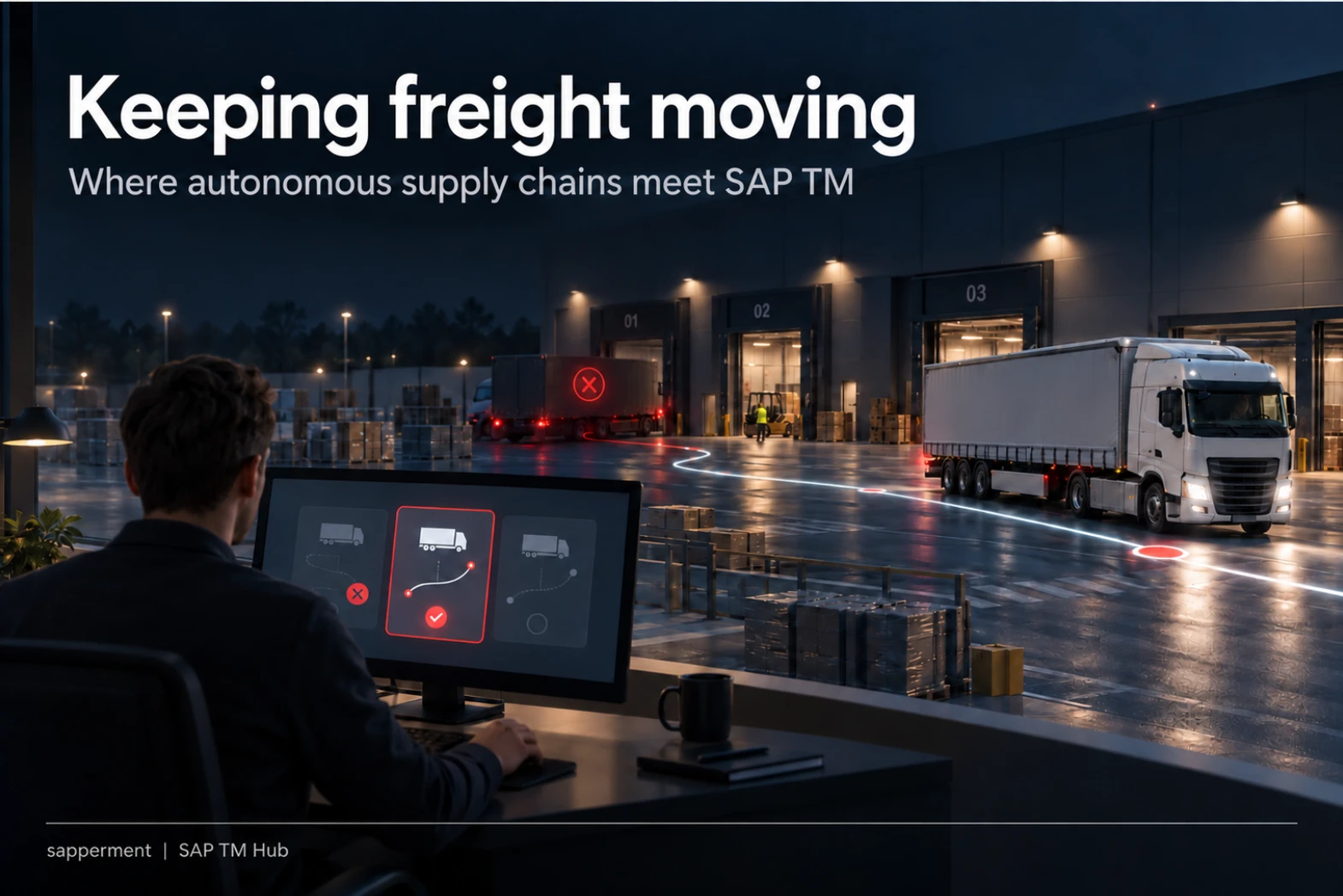
At 16:00, a carrier rejects tomorrow morning’s collection. The goods are ready, the warehouse has reserved a loading slot and the customer still expects delivery.
For the transport planner, the immediate task is to secure a replacement that can collect, deliver and operate within the business’s agreed limits. That requires more than a carrier name and a price. It requires current information, clear authority and coordination with everyone who must execute the revised plan.
SAP’s autonomous supply chain vision brings AI, business data and applications together to coordinate work and support decisions. For TM practitioners, a useful starting point is a familiar operational question: how much of a carrier rejection can we resolve reliably before a planner needs to intervene?
In the companion article, "A recommendation is not execution," I examined the governance boundary between insight and action. This article takes the next step: applying that boundary to a carrier rejection and the operational recovery that follows.
This article proposes a recovery operating model. It does not assume that the complete workflow is delivered as a standard SAP AI capability. Implementation depends on your TM release, deployment, configuration and connected systems.
1. Establish the recovery deadline
A carrier rejection starts several clocks. The tender response deadline, warehouse loading window and latest feasible departure may all be different.
Before searching for a replacement, establish:
- Which freight order and associated transport requirements are affected?
- Is the rejection definitive, and what reason has the carrier supplied?
- When must the replacement accept to leave enough time for warehouse and gate preparation?
- What is the latest collection that still supports the receiving appointment and realistic transit time?
- Who owns the exception if the recovery deadline is missed?
Work backwards from the operational constraints. Giving the next carrier an hour to respond is unhelpful if the warehouse needs a confirmed vehicle in 30 minutes.
Practitioner check: distinguish rejection, no response and a cancellation after acceptance. They may need different recovery paths. A cancellation after acceptance can also require withdrawal or correction of instructions already sent.
2. Assemble a decision-ready picture
The freight order is the transport reference point, but the recovery context extends beyond TM.
| Information needed | What the practitioner must establish |
|---|---|
| Transport requirements | Relevant freight units, quantities, weight, dimensions, equipment, temperature and handling constraints are current. |
| Freight order and tendering | Current carrier assignment, tender responses and execution status allow the proposed next action. |
| Warehouse readiness | Goods can be released and loaded within a confirmed window. Obtain this from warehouse operations or the connected warehouse process. |
| Customer commitment | Delivery window, receiving appointment and authority to change the commitment are explicit. |
| Carrier feasibility | The alternative can provide the required equipment and capacity. A valid rate alone does not confirm availability. |
| Commercial limits | Applicable freight charges, expected extras and approval limits are understood. |
Check when each piece of information was last confirmed. A staging status from this morning may no longer support a collection tomorrow. Missing or conflicting information should trigger verification before an action commits the business.
Practitioner check: retain the freight order reference across carrier communication, warehouse coordination and approval records. Otherwise, the response can fragment into separate email conversations with no reliable view of the agreed plan.
3. Separate rules, optimisation and AI
A credible autonomous logistics discussion should explain which part of the work needs which capability.
| Capability | Role in the proposed recovery process |
|---|---|
| Business rules and workflow | Define eligible carriers, spending limits, response deadlines, approvals and escalation. Trigger routine actions when conditions are met. |
| Planning and optimisation | Evaluate transport options against modelled capacity, timing, compatibility and cost constraints. Results depend on the completeness of those models and inputs. |
| AI assistance | Could interpret rejection messages, assemble information from connected sources and explain differences between recovery options. |
| Agent execution | Could carry out authorised steps through supported application actions, with checks, traceability and exception handling. |
Automatic retendering does not by itself demonstrate AI. Established tendering and workflow mechanisms may already address part of the problem in your landscape.
Use AI where interpreting information or assembling context is the bottleneck. Use explicit rules where the business has already decided what is permitted. Any AI-derived information that affects feasibility must be checked against an authoritative source before execution.
4. Compare feasible alternatives
Consider this illustrative example. All amounts, timings and limits below are assumptions for discussion.
The original freight charge is €1,000. Collection is booked for 07:00–08:00 tomorrow, with delivery required by 14:00. The business permits automatic retendering to approved carriers when the delivery commitment remains unchanged and the additional charge is no more than €100.
On mobile: swipe across to compare all four columns.
| Alternative | Collection and delivery assessment | Expected charge | Proposed treatment |
|---|---|---|---|
| Carrier B | Can meet the existing loading window and delivery commitment, subject to acceptance and capacity confirmation | €1,080 | Eligible for automatic retendering if every required check passes |
| Carrier C | Can meet collection and delivery, subject to confirmation | €1,180 | Prepare approval for the €180 premium |
| Carrier D | Collection only at 10:00; assessed arrival is after 14:00 | €1,020 | Exclude from the unchanged-service recovery; consider only if a revised commitment is authorised |
Carrier B is the first candidate under this policy. Sending a tender to B does not yet secure the recovery. Acceptance, equipment and timing still need confirmation.
The comparison should include expected surcharges and other decision-relevant costs. Where a charge remains uncertain, show that uncertainty and apply the business’s approval rules.
Practitioner check: confirm whether the freight order can be reassigned without replanning. If the alternative changes equipment, routing, stop sequence or shipment allocation, reassess feasibility and affected documents before issuing instructions.
5. Define three response paths
Proceed within approved limits
Retender automatically when all required information is reliable, the carrier is eligible, the shipment remains feasible and cost and service conditions meet the approved policy.
The policy should specify whether tenders are sequential or parallel, how long each response window lasts and how competing responses are resolved. The process must prevent unintended duplicate commitments and deal explicitly with late acceptances.
Prepare a complete approval
When a feasible option exceeds spending authority or changes the customer commitment, send the authorised decision-maker a compact decision package:
- Affected freight order and reason for recovery.
- Recommended carrier and confirmed or outstanding feasibility checks.
- Expected total charge and variance against the original plan.
- Effect on collection, delivery and warehouse activity.
- Decision deadline and consequence of no response.
Route cost approval and customer-service approval to the appropriate owners. Permission to spend more does not automatically authorise a later delivery.
Escalate with an owner and deadline
Escalate when no feasible alternative exists, data is unreliable, a required action fails or the shipment falls outside the approved process.
Urgent or regulated shipments need explicit eligibility rules. They may proceed automatically only where their specific requirements are covered and the necessary checks pass.
Assign a named role to take over. An alert without an owner and an acknowledgement deadline can leave the shipment unattended.
6. Make the revised plan executable
Once a replacement accepts, coordinate the changes required for collection.
For the transport process, ensure the agreed carrier, timing and relevant instructions are reflected consistently in TM and carrier communication. Handle the previous tender or assignment through the appropriate process so it cannot create a conflicting commitment.
For warehouse and yard operations, confirm that the replacement arrival fits the loading arrangements. Update the information needed for slot management, staging, gate entry and loading, wherever those activities are managed in your landscape.
For customer service, communicate any authorised delivery change and confirm who updates the customer-facing commitment. Routine internal recovery does not always require a customer message; the communication policy should make that distinction clear.
These handoffs need acknowledgement. If a carrier update succeeds but the warehouse update fails, treat the recovery as incomplete and assign the outstanding action.
A transport plan becomes executable when the carrier, warehouse and responsible teams can act on the same agreed information.
7. Measure the plan and the physical outcome separately
Use time to a confirmed, feasible recovery as the primary measure for the coordination process.
Start the clock when a valid rejection is received by the responsible recovery process. Stop it when the replacement carrier has accepted, required feasibility checks and approvals are complete, and affected execution teams have confirmed the arrangements. Record the actual event time as well, so an integration delay does not disappear from the analysis.
That measures how quickly the replacement plan is secured. Collection and delivery performance show whether it worked.
| Measure | What it reveals |
|---|---|
| Time to confirmed, feasible recovery | How quickly the business secures an executable replacement plan |
| Collection within the agreed window | Whether the recovery reaches physical execution as intended |
| Delivery against the agreed commitment | Whether customer service is protected; retain the original commitment as a comparison if it changes |
| Additional transport cost | The cost of recovery, including agreed extras and later differences |
| Planner intervention rate | How often the process needs a person, with reasons for intervention |
| Reopened recoveries | How often an apparently secured plan fails and requires another response |
Report typical and slower cases, for example median and 90th-percentile recovery times. Averages alone can conceal the exceptions that miss the collection window.
Carry approved charge changes and their rationale through charge calculation and freight settlement. Compare expected recovery cost with the charges ultimately settled. Otherwise, a fast operational response can become an unexplained financial variance.
Start with one exception on one lane
Choose a lane with recurring carrier rejections, usable operational data and clear business ownership.
First, review recent cases. Establish where time was lost: interpreting the rejection, finding capacity, obtaining approval or coordinating collection. Define the permitted response and the required evidence for each step.
Then run the proposed logic alongside the planners’ existing process without letting it commit changes. Compare its suggested actions with actual decisions and investigate disagreements. This exposes missing constraints, stale data and unclear authority before automatic execution begins.
Enable a narrow set of authorised actions once those checks are reliable. Agree who can pause automation, how work returns to a planner and how outstanding tenders are handled during that handover.
Expand based on recovery time, service performance and cost together. A faster response is valuable when the resulting shipment can still be executed as agreed.
When a carrier rejects a collection, where does your recovery lose the most time: finding capacity, getting approval or coordinating the warehouse?
Sources and notes
- SAP News Center: Moving Toward a More Autonomous Supply Chain. Dominik Metzger, president and chief product officer, SAP Supply Chain Management, 14 May 2026, accessed 31 October 2026. The operating-model vision this article starts from.
- SAP SE: Freight Order Management. SAP Help Portal, Transportation Management (TM) in SAP S/4HANA, version 2025 FPS02 (October 2026), accessed 13 October 2026. Freight orders, tendering and their integration with planning and settlement.
- SAP SE: Freight Settlement Document. SAP Help Portal, Transportation Management (TM) in SAP S/4HANA, version 2025 FPS02 (October 2026), accessed 7 October 2026. Posting of approved charge changes through a purchase order and service entry sheet in MM.
Note on evidence: this article describes a proposed recovery operating model drawn from practitioner experience. It does not describe a delivered SAP capability; implementation depends on release, deployment, configuration and connected systems.
Companion article on governance: "A recommendation is not execution." Or meet Deborah Born and explore the SAP TM Hub.