A recommendation is not execution
The governance gap between SAP TM and the autonomous supply chain
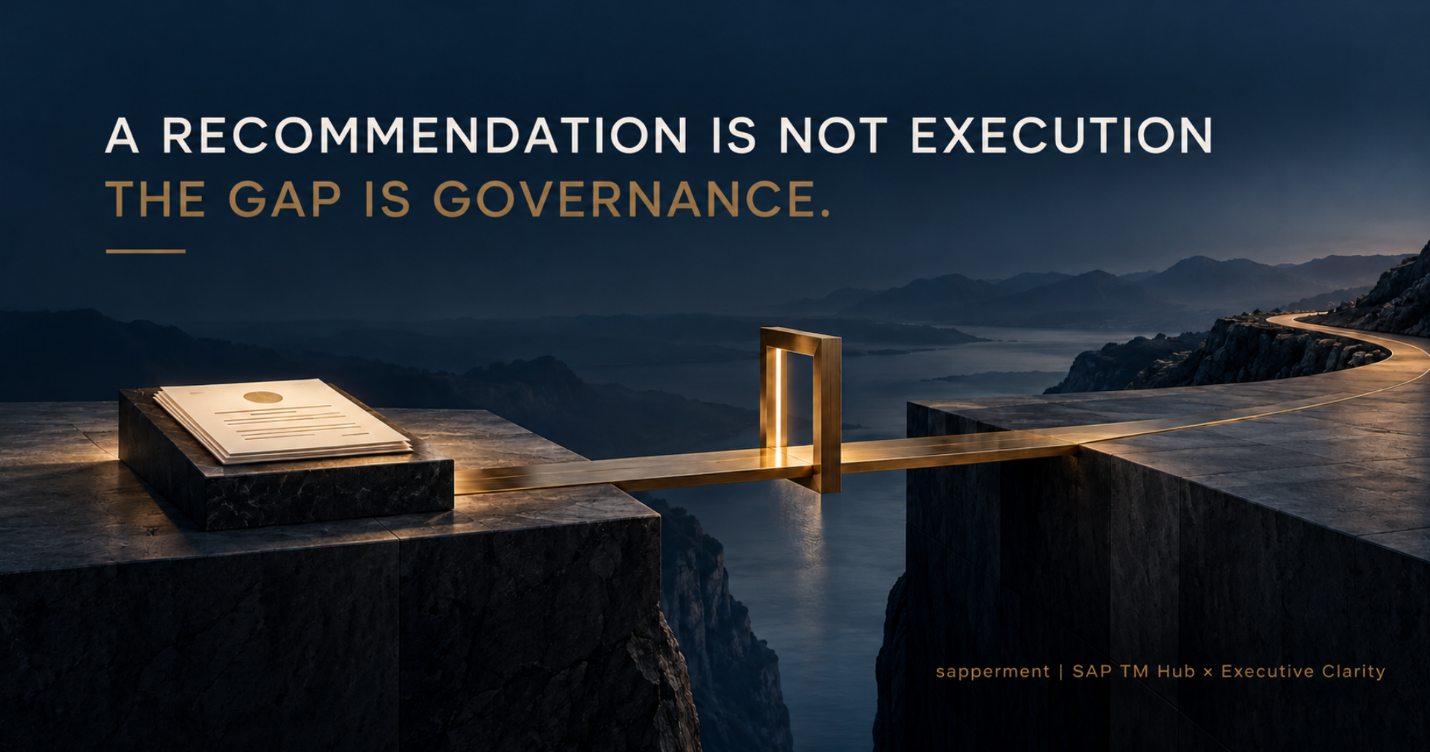
A recommendation document and an execution path are separated by a governance threshold. The system may recommend what should happen. The organisation must still be able, and authorised, to act.
A recommendation is not a decision.
And a decision is not execution.
That distinction sits behind much of today’s discussion about AI, supply-chain orchestration and autonomous operations.
Systems are becoming better at detecting disruption, assessing impact and recommending a response. But identifying the right action is only the beginning.
Someone, or something, must decide whether the recommendation should be accepted. The decision must then reach the operational systems, people and partners capable of executing it. The outcome must be monitored and fed back into the wider supply-chain picture.
The full chain is:
Signal → impact → recommendation → decision → execution → outcome
Every transition introduces a possible break.
SAP Transportation Management provides a useful way to examine that gap because transportation is where an abstract supply-chain decision often becomes a physical movement, with real carriers, capacity, cost and customer consequences.
One disruption, several decisions
Consider a critical supplier reporting a three-day delay.
The immediate signal is straightforward: an inbound shipment will arrive late.
But the business impact may travel much further:
Supplier delay → inbound transportation → material availability → production plan → customer order → outbound transportation → customer promise
Several responses may be possible:
- source the material elsewhere;
- reallocate existing inventory;
- change the production sequence;
- reprioritise customer orders;
- change the transportation mode;
- select another carrier;
- expedite the affected shipment.
Suppose the recommended response is:
Expedite the material by air and protect the production order.
Technically, that may be the best answer.
But it immediately creates a second set of questions.
- Who may accept the additional transportation cost?
- Which production order or customer commitment receives priority?
- What happens if protecting service damages margin?
- Can the operational landscape execute the response quickly enough?
- Does an appropriate carrier have capacity?
The recommendation may be intelligent. That does not yet make it executable.
The executive lens: who owns the trade-off?
For a COO, CSCO or CFO, the central issue is not whether the system can produce a recommendation.
It is whether the organisation has agreed how competing outcomes should be balanced.
The air-freight decision may protect production and customer service while increasing logistics cost. Another response may preserve margin but expose revenue or a strategic customer commitment. A third may shift the impact to another plant, region or business unit.
These are business trade-offs, not technical exceptions.
Effective orchestration therefore needs more than visibility and analytics. Five elements must connect:
- A reliable signal. The organisation must know that something material has changed.
- A clear view of the impact. The signal must be connected to the affected materials, orders, facilities, customers and financial outcomes.
- An agreed decision framework. Cost, service, revenue, risk and strategic priorities must be balanced through explicit rules, not personal interpretation during each disruption.
- Authority to act. A person, role or governed agent must have permission to accept the trade-off.
- Closed-loop execution. The chosen action must reach the operational process, and its outcome must become visible.
Without these foundations, the organisation gains better visibility without necessarily becoming better at responding.
The executive objective is not more recommendations. It is to turn the right recommendation into a controlled business response.
The execution lens: can SAP TM deliver the response?
The broader orchestration process can evaluate the disruption across procurement, planning, manufacturing, inventory, logistics and customer service.
SAP TM then becomes one of the systems in which the chosen response must become operational.
If the decision is to expedite by air, the transportation landscape needs more than a textual instruction saying “use air freight.”
It may need:
- identifiable transportation demand;
- an executable air-freight route and service;
- suitable carriers and agreements;
- current rates and accessorial charges;
- schedules and capacity assumptions;
- planning and incompatibility constraints;
- a replanning process that can change the original decision;
- approval rules for the additional cost;
- connections to warehouse, carrier and execution processes.
If these elements do not exist, air freight is not yet an executable alternative. It is only an idea contained in the recommendation.
This is where good recommendations die: between what the business wants to do and what the execution landscape has been designed to support.
The architectural principle should therefore be:
The orchestration layer should recommend actions that map to a viable execution path, or make the missing prerequisites visible before the decision is approved.
That is more realistic than assuming every theoretically attractive response can already be executed.
The project lens: where should the governance threshold sit?
Every SAP TM project eventually encounters the same design question:
Where should the boundary sit between a recommendation and an executable transportation decision?
There are four broad models.
1. Recommend and wait
The system identifies the response, but a planner evaluates, approves and executes it.
This provides strong human control but may be too slow for disruptions where capacity or service options disappear quickly.
2. Recommend, approve and execute
The system recommends the response. A person approves it, and the system carries out the operational changes.
This removes manual execution effort while preserving an explicit human decision.
3. Act within guardrails
The system may decide and execute when the response remains within predefined cost, service, carrier and risk tolerances.
A planner becomes involved only when the proposed action exceeds those boundaries.
4. Coordinate autonomously across domains
Agents or systems coordinate the decision across planning, procurement, manufacturing and logistics, execute the agreed response and escalate only material exceptions.
This is the most ambitious model, and the one requiring the strongest data, governance, process integration and auditability.
The right answer will not be the same for every decision.
Automatically retendering within an approved carrier pool and cost tolerance is different from switching an urgent shipment from ocean to air. Rebooking a routine lane is different from accepting a cost increase that changes product margin or customer profitability.
Autonomy should therefore be assigned decision by decision, not declared for an entire supply chain.
The governance threshold
The governance threshold is the point at which a recommendation becomes an authorised action.
It should define:
- which decisions may be automated;
- which conditions must be satisfied;
- which cost and service tolerances apply;
- which carriers, routes and modes are permitted;
- which customer or production priorities override others;
- when human approval is mandatory;
- who is accountable for the outcome;
- how the action and rationale are recorded.
If these rules live only in an experienced planner’s head, the process is not ready for autonomy.
The planner may still make excellent decisions, but the organisation has not yet converted that judgment into a repeatable and governable operating capability.
The external network cannot be assumed
Transportation also depends on participants outside the enterprise.
Carrier acceptance, available capacity, collection events, port delays, estimated arrival times and subcontractor performance may all affect the decision.
Connecting to a business network can provide the channel. It does not guarantee that every carrier supplies complete, timely and reliable operational data.
Connectivity is not participation.
Before increasing autonomy, organisations therefore need to ask:
- Which partners provide sufficiently reliable signals?
- Which execution actions can be confirmed digitally?
- Where do manual communication and incomplete events remain?
- Can the organisation distinguish a missing event from an actual operational failure?
An autonomous response built on incomplete external signals can act quickly and still act incorrectly.
The four models describe how an individual decision can be governed. The maturity ladder below describes how the organisation's overall capability develops.
The destination: autonomy is earned
An autonomous supply chain is not created by switching on an agent.
It develops through increasing levels of operational trust:
| Level | System role | Human role |
|---|---|---|
| Visible | Detects and presents the disruption | Investigates and acts |
| Advisory | Assesses impact and recommends a response | Decides and executes |
| Governed execution | Recommends and executes after approval | Approves material decisions |
| Guardrailed autonomy | Decides and acts within explicit boundaries | Governs rules and handles exceptions |
| Autonomous coordination | Coordinates and executes across domains | Governs the framework and material exceptions |
Progress depends on more than smarter technology.
It requires trusted signals, connected business objects, executable master data, clear decision rights, operational integration and evidence that the previous level works reliably.
The organisations that move successfully toward autonomous supply chains will not simply be those with the smartest recommendations.
They will be those that systematically close the distance between insight and action.
SAP TM provides a particularly clear test. When the wider supply chain identifies the right response, can transportation execute it, with the required speed, data, authority and control?
A recommendation may show the way forward.
Governance is what allows the organisation to cross.
Sources and notes
- SAP SE: Constraints for VSR Optimization. SAP Help Portal, Transportation Management (TM) in SAP S/4HANA, version 2025 FPS02 (October 2026), accessed 13 October 2026. Documents how VSR optimisation distinguishes hard constraints from soft constraints modelled through penalty costs. Used here as an example of how planning boundaries and tolerances can be represented in SAP TM.
- SAP News Center: Moving Toward a More Autonomous Supply Chain. Dominik Metzger, president and chief product officer, SAP Supply Chain Management, 14 May 2026, accessed 31 October 2026. The operating-model vision this article engages with.
Note on evidence: The governance models, threshold definition and maturity ladder are the author's frameworks, informed by practitioner and advisory experience. They do not describe delivered SAP capability.
Continue with the practitioner scenario: "Keeping freight moving: where autonomous supply chains meet SAP TM." Or meet Deborah Born and explore the SAP TM Hub.